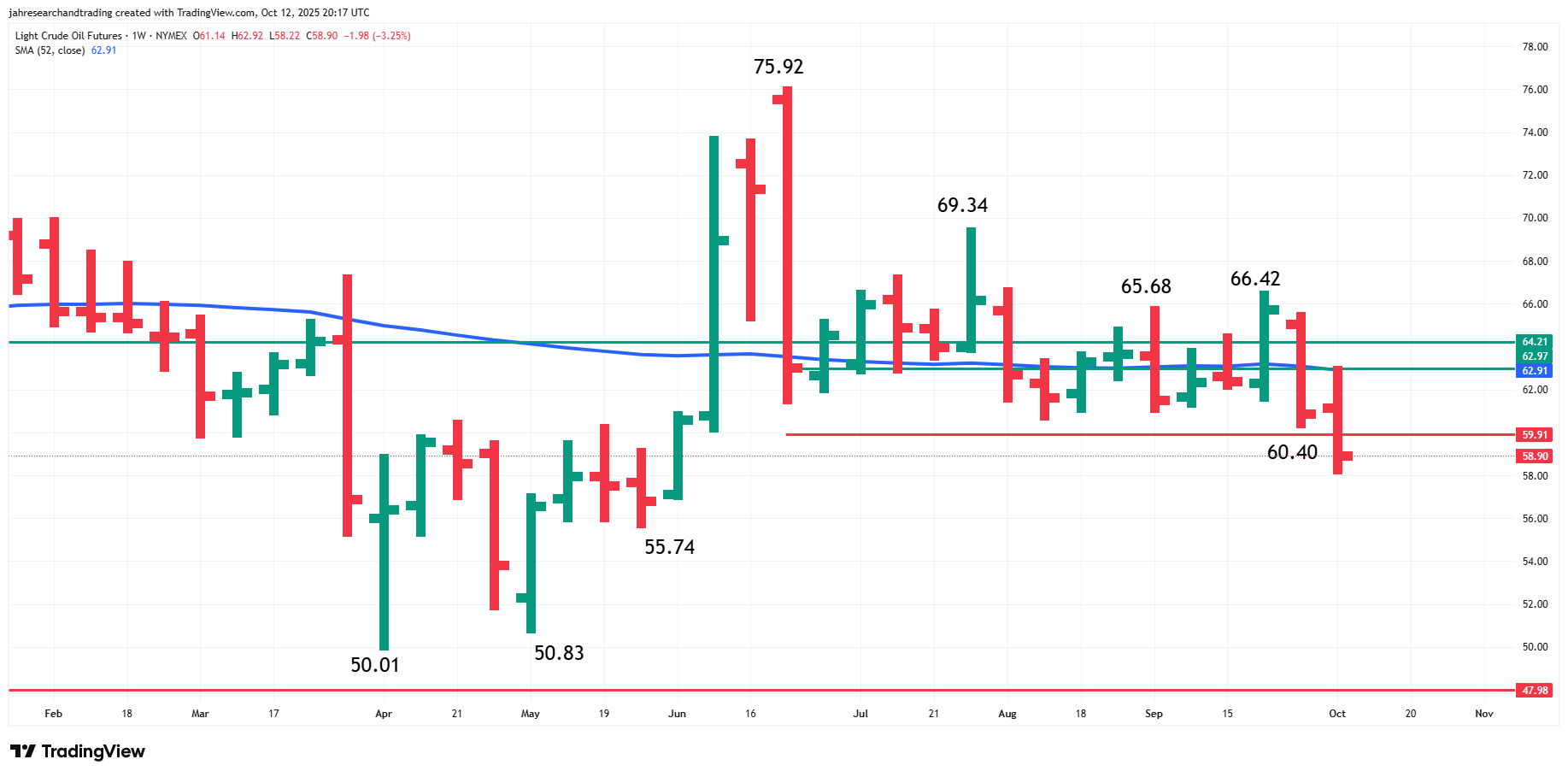



 WTI crude oil futures closed the week sharply lower, breaching the major Fibonacci support level at $59.91 and confirming a deeper bearish structure. This marks the weakest weekly settlement since early June and shifts the technical tone firmly negative heading into the new trading week.
The decline was driven by unwinding geopolitical risk premiums following a ceasefire agreement between Israel and Hamas. Meanwhile, renewed trade tensions—sparked by U.S. tariff threats against China—added to macroeconomic concerns and triggered broad-based selling in risk assets, including crude.
Last week, Light Crude Oil Futures settled at $58.90, down $1.98 or -3.25%.
OPEC+ Restraint Overshadowed by Rising Global Supply
Despite OPEC+ maintaining only a modest output increase of 137,000 barrels per day for November, the production outlook remains bearish. Traders are now increasingly focused on resurgent U.S. output, which the EIA has revised higher to a record 13.53 million bpd for 2025. Additional barrels from Venezuela, Kurdish regions, and Middle Eastern exporters further weigh on the global balance.
Easing fears of near-term shortages have pulled attention away from OPEC+ policy moves and toward the broader supply picture, which now appears to be tilting firmly toward oversupply into year-end.
Geopolitical Premium Unwinds, Pressuring Oil Prices
The Middle East ceasefire has cooled a major source of geopolitical tension that had supported prices in recent months. With threats to Red Sea shipping routes and Iranian supply disruptions now seen as less imminent, the risk premium has narrowed considerably. Analysts warn that unless new supply disruptions emerge, crude may struggle to hold above key technical levels.
Weekly Technical Breakdown Signals Deeper Losses Ahead
On the weekly chart, WTI’s break below $59.91 Fibonacci support represents a major bearish trigger. This level now acts as first resistance on any bounce. More significantly, the market has slipped decisively below the 52-week moving average at $62.91, the primary trend indicator used by institutional traders to gauge directional bias.
Momentum is now building toward the next downside target at $55.74, with a broader support zone waiting below between $50.83 and $47.98. These areas provided strong demand in 2023 and will be closely watched in the coming weeks.