


 Australia has a trade-to-GDP ratio of over 50%. China’s trade terms can affect the Australian economy, given that China accounts for one-third of exports.
RBA Governor Michele Bullock has previously commented on the Bank’s focus on China’s economic data and policy measures. In July, Governor Bullock stated:
“Trade terms with China remain crucial. If China bolsters its economy with fiscal stimulus, that could cushion the impact of tariffs on Australia’s economy.”
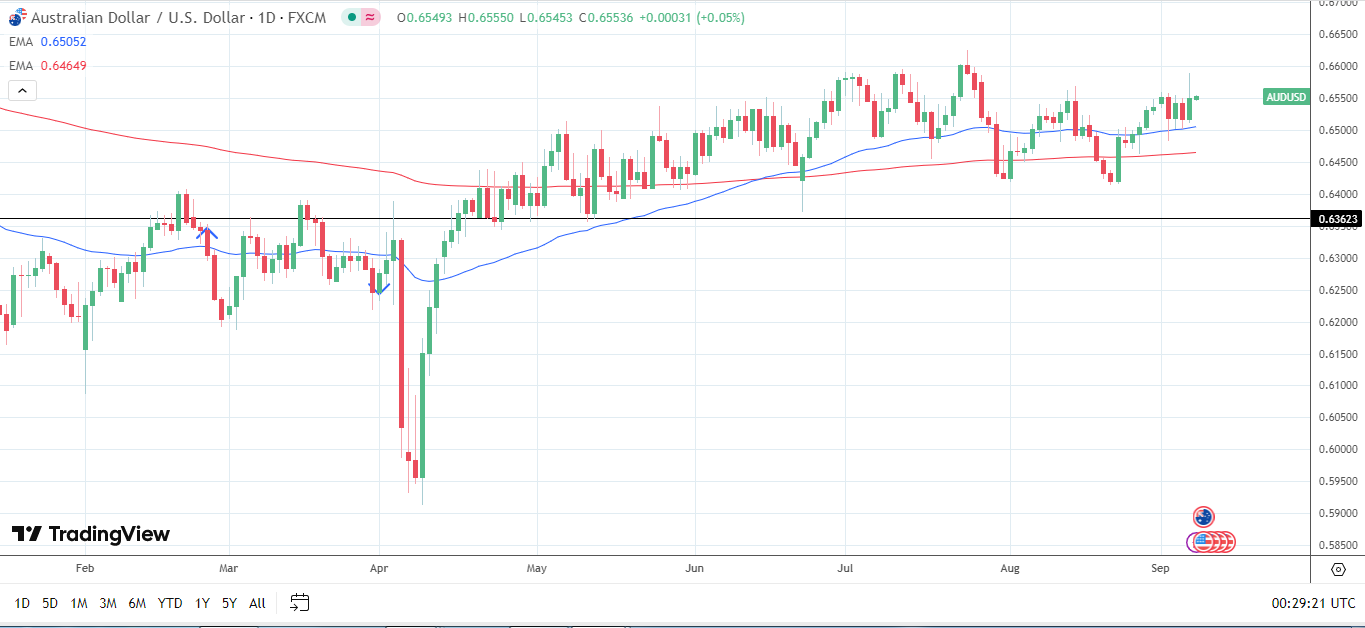
For context, the AUD/USD gained 0.31% on August 7, closing at $0.65226. China reported exports of 7.2% (year-on-year) in July, up from 5.8% in June, lifting AUD/USD.
AUD/USD: Key Scenarios to Watch
Bearish AUD/USD Scenario: Weaker trade data or dovish RBA signals. These factors could push AUD/USD toward the $0.65 level.
Bullish AUD/USD Scenario: Strong China data or hawkish RBA cues. These factors could send AUD/USD toward the $0.66 resistance level.
Falling consumer inflation expectations would support multiple Fed rate cuts. A more dovish Fed policy stance would narrow the US-Aussie interest rate differential in favor of the Aussie dollar. Under this scenario, the AUD/USD pair could rise toward the crucial $0.66 level, potentially bringing the July 24 high of $0.6625 into play.
Conversely, a higher reading may indicate a less dovish Fed rate path. Fading bets on Q4 Fed rate cuts could widen the rate differential, pushing AUD/USD toward the 50-day Exponential Moving Average (EMA). If breached, the 200-day EMA would be the next key support level.