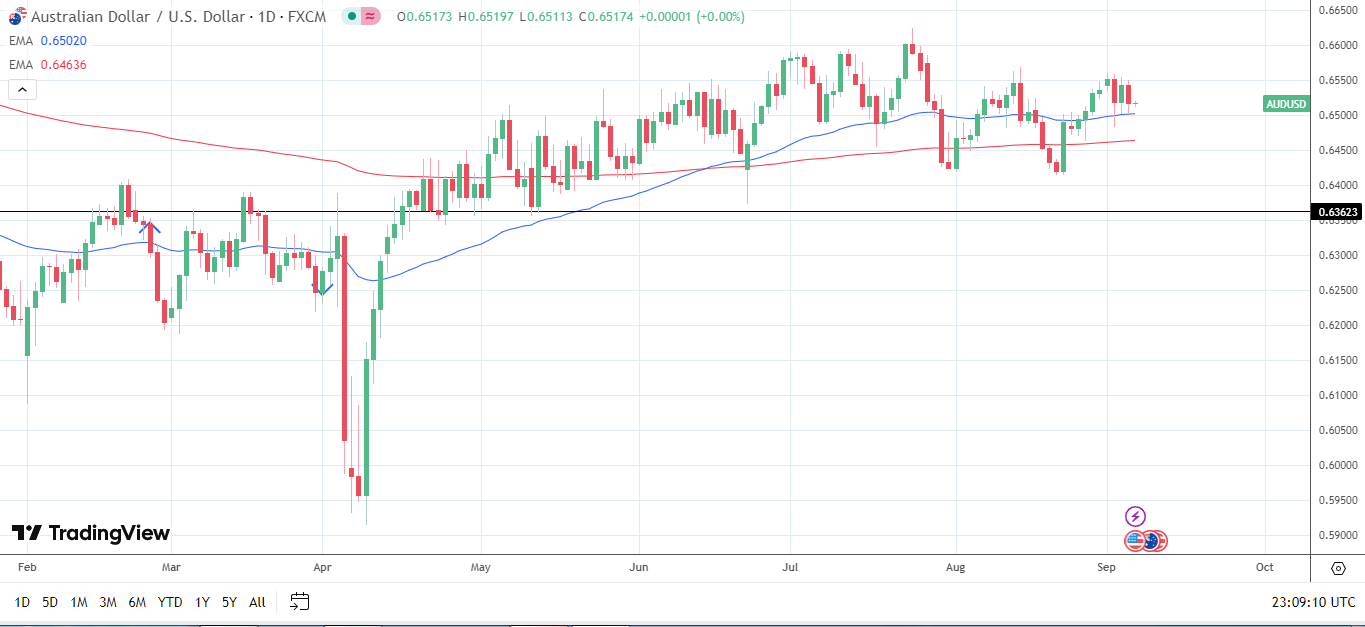



 Turning to the AUD/USD pair, Australian labor market data will influence sentiment toward RBA monetary policy. The ABS will release the labor account and multiple job-holder data for the June quarter.
Declines in total and filled jobs may affect wage growth and consumer spending. Softer spending could dampen demand-driven inflation. A more dovish RBA policy stance would weigh on the Aussie dollar. Conversely, rising total jobs and filled jobs could temper market expectations for an RBA rate cut, lifting appetite for the Aussie dollar.
For context, the ABS reported a 0.2% fall in total jobs and a 0.1% decline in filled jobs in the March quarter. Significantly, multiple job-holders slid 2.8% in the quarter. Unemployment increased from 4% in December 2023 to 4.1% in March 2024. Aussie unemployment rose to 4.3% in June 2025, the highest level since November 2021, suggesting weak numbers.
AUD/USD: Key Scenarios to Watch
Bearish AUD/USD Scenario: Weaker jobs data or dovish RBA rhetoric. These factors could push AUD/USD toward the $0.65 level.
Bullish AUD/USD Scenario: Positive data or hawkish RBA signals. These factors could send AUD/USD toward the $0.6550 resistance level.
See our full AUD/USD analysis for detailed trends and trade setups.
While economists expect a Q4 RBA rate cut, uncertainty lingers over the Fed’s rate path through the fourth quarter.
A cooling US labor market would support multiple Fed rate cuts, narrowing the US-Aussie interest rate differential in favor of the Aussie dollar. A narrower rate differential may send AUD/USD toward the $0.6550 level.
Conversely, data reflecting a resilient US labor market may signal a less dovish Fed rate path. Expectations of fewer Fed rate cuts may widen the rate differential, sending AUD/USD toward the 50-day Exponential Moving Average (EMA) and the $0.65 support level. If breached, the 200-day EMA would be the next key support level.