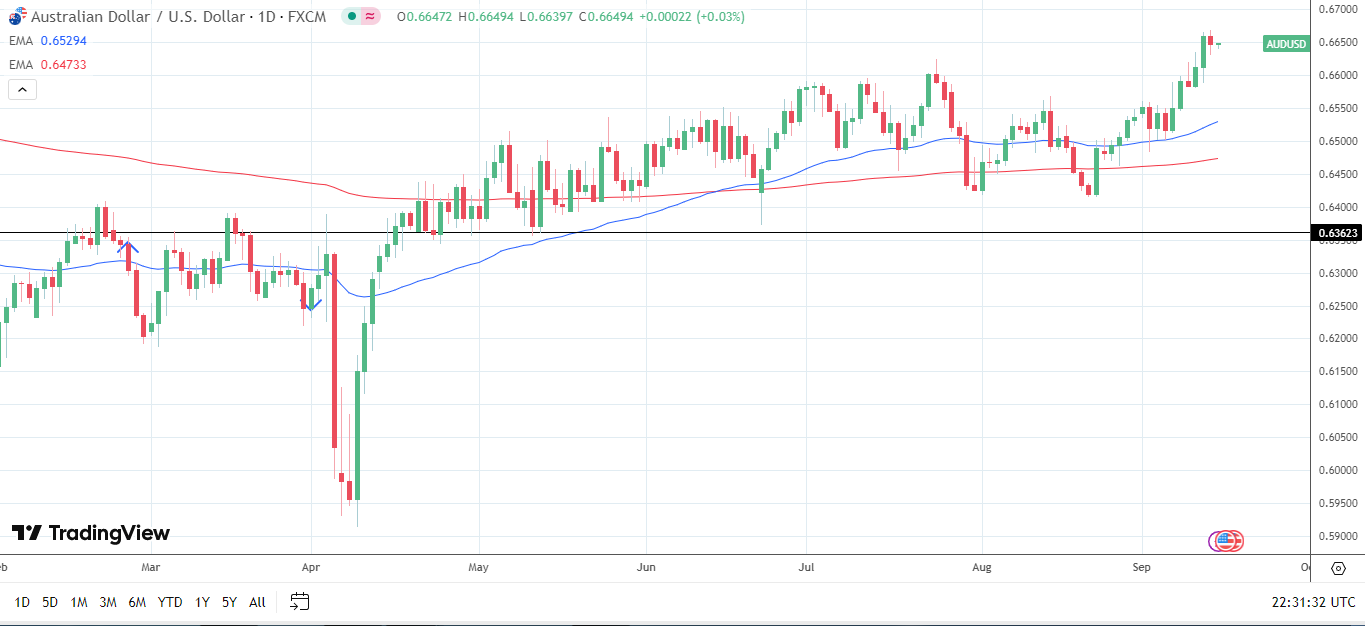



 Shifting focus to the AUD/USD pair, Chinese house prices, industrial production, retail sales, and unemployment figures will influence demand for the Aussie dollar.
A softer fall in house prices, a sharper rise in retail sales, a pickup in industrial production, and falling unemployment could signal a resilient Chinese economy.
Improving demand from China could boost the Aussie economy, given that China accounts for around one-third of Aussie exports. Aussie trade terms are crucial for the RBA, given that Australia has a trade-to-GDP ratio of over 50%.
Upbeat data could temper expectations of a November RBA rate cut, driving demand for the Aussie dollar.
On the other hand, softer data may signal weakening demand, fueling speculation about a November rate cut and further policy easing in early 2026. A more dovish RBA policy stance would weigh on the Aussie dollar.
AUD/USD: Key Scenarios to Watch
Bearish AUD/USD Scenario: Weak Chinese data or dovish RBA rhetoric may push AUD/USD toward $0.66.
Bullish AUD/USD Scenario: Strong Chinese data or hawkish RBA chatter could drive AUD/USD toward $0.67.
While economists predict a November RBA rate cut, traders are betting on multiple Fed rate cuts, sending AUD/USD through the $0.66 level.
A larger-than-expected fall in the NY Empire State Manufacturing Index could boost expectations of aggressive Fed rate cuts. A more dovish Fed policy stance would narrow the interest rate differential in favor of the Aussie dollar. Under this scenario, AUD/USD could target $0.67.
However, a higher reading could reduce bets on multiple Fed rate cuts in the fourth quarter. A less dovish Fed rate path may widen the rate differential, dragging AUD/USD toward $0.66.