


 Meanwhile, Australian building activity could give insights into the real estate market and house price trends, influencing RBA rate cut bets and the AUD/USD pair.
Building approvals and commencement numbers indicate the pipeline of new housing supply. A jump in approvals may increase supply, potentially cooling house price growth. On the other hand, falling approvals could constrain supply, driving prices higher.
Housing supply trends can reflect economic sentiment. Supply trends may also influence rental prices and the RBA rate path. Lower supply may lead to reduced vacancy rates, fueling housing services inflation, which represents around 23% of the Consumer Price Index (CPI). Conversely, increased supply could ease rental price pressures, potentially cooling housing services inflation. The total number of dwellings commenced fell 4.4% in Q4 2025.
AUD/USD Daily Outlook: Producer Prices to Drive Rate Differentials
Later today, US producer prices would likely influence US-Australian interest rate differentials and AUD/USD trends.
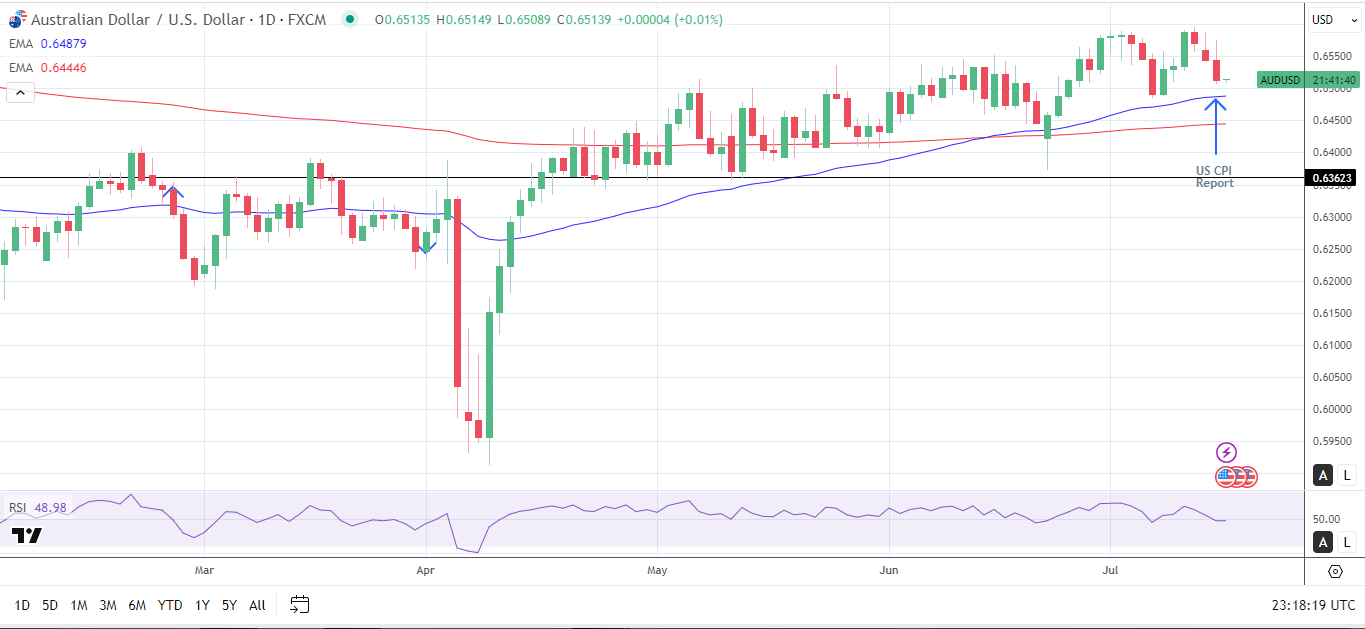
A larger-than-expected rise in producer prices may temper Fed rate cut bets, widening the rate differential in favor of the US dollar. A wider rate differential could push AUD/USD toward $0.65, exposing the 50-day EMA.
Conversely, lower-than-expected producer prices could narrow the rate differential, favoring the Aussie dollar. Rising bets on a September Fed rate cut may push the pair toward $0.66.
On July 15, the US CPI Report revealed sticky core inflation and rising headline inflation, tempering Fed rate cut expectations. AUD/USD briefly climbed to a high of $0.65758 before sliding to a session low of $0.65074 in reaction to the inflation data. The price action underscored sensitivity to US inflation data and Fed rate cut bets.