


 On Wednesday, July 16, the Reuters Tankan Index provided insights into Japan’s economy, spotlighting the USD/JPY pair. The Reuters Tankan Index rose from 6 in June to 7 in July.
The Index reflects sentiment across the private sector, potentially influencing the Bank of Japan’s policy stance. A higher index reading could raise expectations of a 2025 BoJ rate hike, lifting Yen demand.
Notably, the Tankan surveys for Q2 revealed manufacturers cut profit forecasts and signaled worsening business conditions in the coming months. Meanwhile, non-manufacturers also waned over concerns about labor costs and the effect of rising prices on domestic demand. The Tankan Large Manufacturers Index rose from 12 in Q1 to 13 in Q2, while the Tankan Large Non-Manufacturers Index slipped to 34 in Q2, down from 35 in Q1.
Despite sector-specific concerns, the overall sentiment remained resilient, supporting further BoJ monetary policy tightening. The higher Reuters Tankan Index may reinforce sentiment toward the BoJ’s policy stance.
While the Tankan data is influential, trade developments will be crucial since Japan faces a 25% US tariff effective August 1.
USD/JPY Daily Outlook: US Producer Prices and Fed Policy Speculation
Later in the session on Wednesday, producer prices will influence Fed rate hike expectations. Economists expect producer prices to rise 2.5% year-on-year in June, down from 2.6% in May.
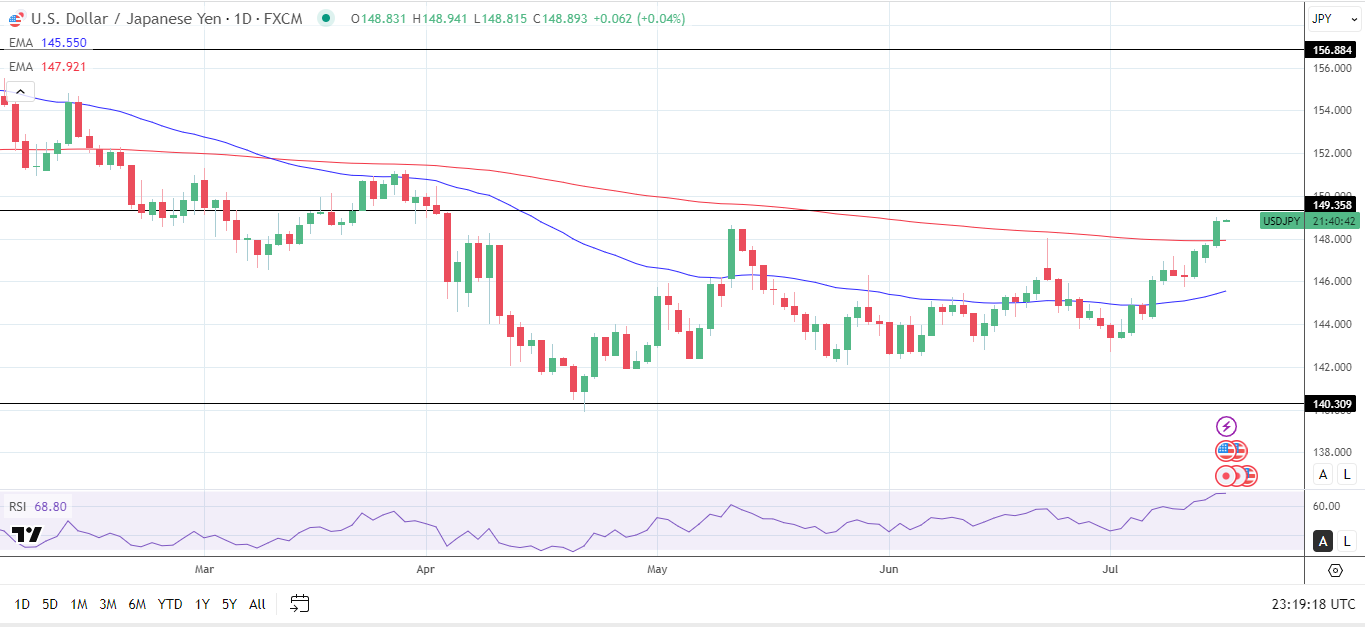
Producers typically lower prices in a weakening demand environment, passing cost savings on to consumers. Lower prices could raise bets on a September Fed rate cut, pushing USD/JPY toward the 200-day EMA, potentially exposing the 50-day EMA. Conversely, higher prices may signal a more hawkish Fed rate path, driving the pair toward the 149.358 resistance level.
USD/JPY: Key Scenarios to Watch
Bearish USD/JPY Scenario: Progress toward a US-Japan trade deal, softer US data, hawkish BoJ signals, or dovish Fed cues. Such factors could push USD/JPY toward the 200-day EMA and potentially the 50-day EMA.
Bullish USD/JPY Scenario: Rising US-Japan trade tensions, higher US producer prices, dovish BoJ signals, or hawkish Fed rhetoric. These may drive the pair toward the 149.358 resistance level.