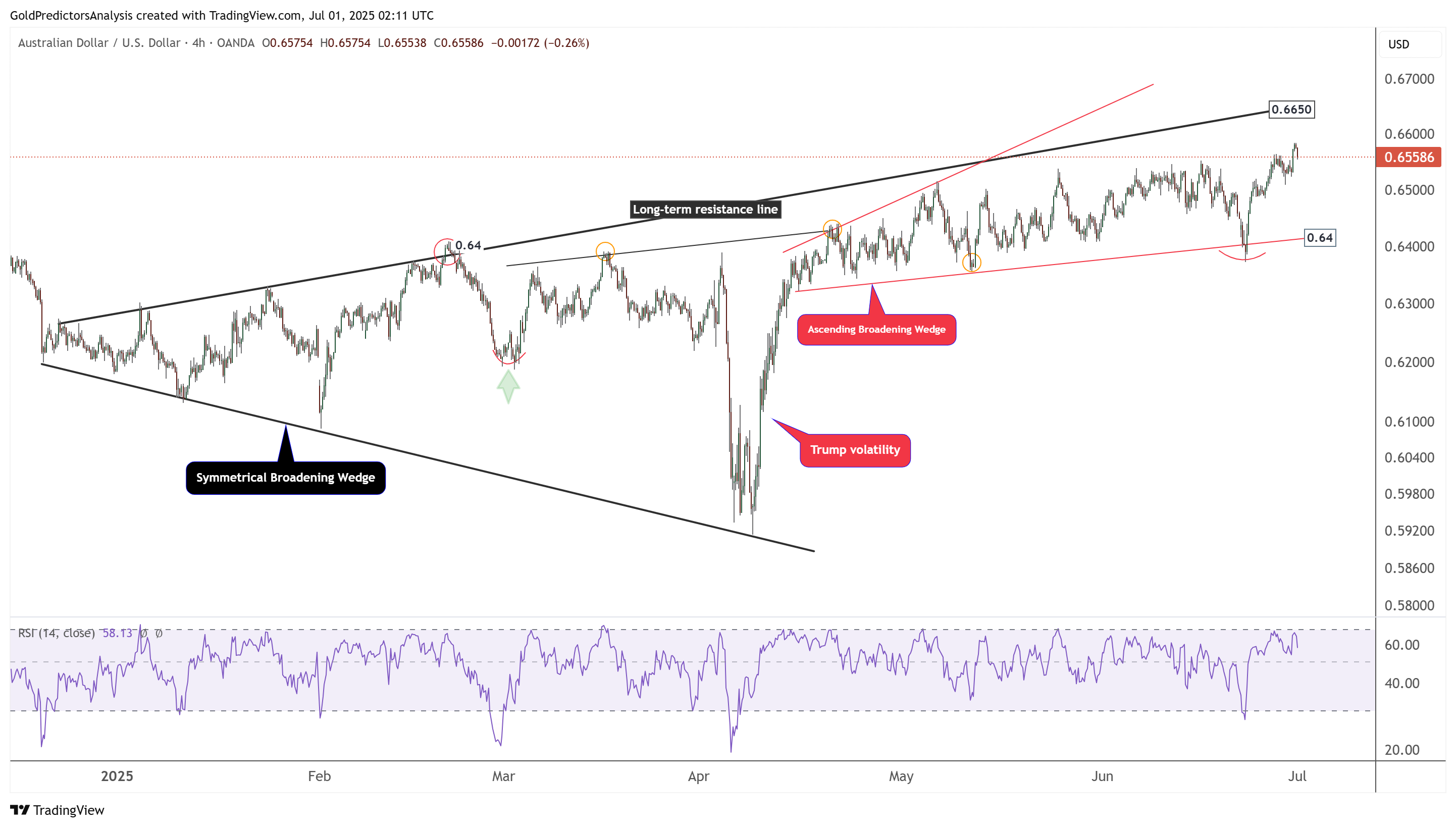



 The Australian Dollar (AUD) edged lower against the US Dollar (USD) on Tuesday, despite remaining within a broader bullish trend. The AUD/USD pair corrected following the release of Australia’s S&P Global Manufacturing PMI, which fell to 50.6 in June from 51.0 in May. The chart below shows a continuous decline in manufacturing PMI since March 2025.
This decline marked the lowest output reading since February. Moreover, the new orders fell for the first time in five months. Weak market conditions and sufficient client inventories weighed on demand. The weaker PMI reading dented confidence in the Australian economy.
However, China’s Caixin Manufacturing PMI offered some support, as shown in the chart below. It rose to 50.4 in June, up from 48.3 in May. As China is Australia’s largest trading partner, improvements in Chinese manufacturing can help stabilise the AUD sentiment.
The 4-hour chart for AUD/USD shows that the price is trading within an ascending broadening wedge pattern. The formation of this pattern inside a larger symmetrical broadening wedge indicates intense volatility. Bearish pressure on the US Dollar Index has led to increased demand for the Australian dollar, pushing the pair higher. Key resistance is located at 0.6650, while strong support is evident at 0.6400. A break above 0.6650 would signal further upside in AUD/USD.