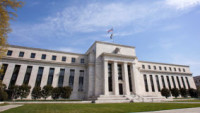



 Kevin Warsh has played a pivotal role in the current market dynamics. His staunchly “hawkish” rhetoric following the September FOMC meeting not only paved the way for US dollar purchases but also firmly blocked attempts at mass selling. Speculators, who had been actively dumping the greenback for seven weeks, were caught completely off guard. Consequently, EURUSD recorded its steepest plunge in three weeks. Nevertheless, further downward momentum will require fresh fundamental catalysts.
The Federal Reserve proceeded with rate hikes, defying Donald Trump’s direct wishes. This move proved sufficient to restore confidence not only in the central bank itself but also in US assets broadly. The Fed has now aligned with other central banks, such as the ECB and the Bank of Japan, which are also tightening monetary policy to combat inflation. However, analysts at Brown Brothers Harriman argue that the dollar’s potential to reach new cyclical highs is limited, given that its global peers are pursuing similarly restrictive policies.
The futures market is pricing in two Fed rate hikes over the next year, while leaving room for a potential third. The ECB is expected to deliver a similar pair of hikes, with the probability of a third move exceeding 50%. Investors are also confident in rate increases from the Bank of England (by 75, or even 100 basis points) and the Bank of Japan’s overnight rate. However, the dollar does not necessarily gain an edge purely from the pace of tightening. Furthermore, the September FOMC meeting has already been fully priced in, setting the stage for a short-term technical bounce in EURUSD.
The major currency pair managed to find its footing, aided by a rally in USDJPY. The Japanese yen weakened following market disappointment over a divided Bank of Japan Board of Governors regarding a potential hike in the overnight rate from 1% to 1.25%. In an environment of low volatility and high global risk appetite, the carry trade strategy thrives. When the yen recently strengthened, traders pivoted to the euro as their funding currency. Now, with the yen weakening again, they have reverted to their previous playbook, which has provided temporary support for the euro.
Nevertheless, the euro’s fundamental footing remains precarious. The currency faces mounting political risks in Germany and France, alongside the looming specter of a new energy crisis. Moreover, it is far from certain that the Eurozone economy can absorb a cycle of ECB rate hikes as painlessly as the US economy is handling the Fed’s tightening.
Additionally, the dollar still holds an old but reliable trump card: the concept of “American exceptionalism.” All it takes to activate this is for US business activity data to demonstrate clear superiority over European counterparts.
In summary, the bearish trend for EURUSD has strong odds of continuing, though a short-term upward correction remains a possibility. From a technical standpoint: a decisive breakout below $1.1495 could trigger a bounce and create euro buying opportunities, whereas rejection at the $1.1505, $1.1540, and $1.1555 zones would provide fresh signals to resume short positions (selling).