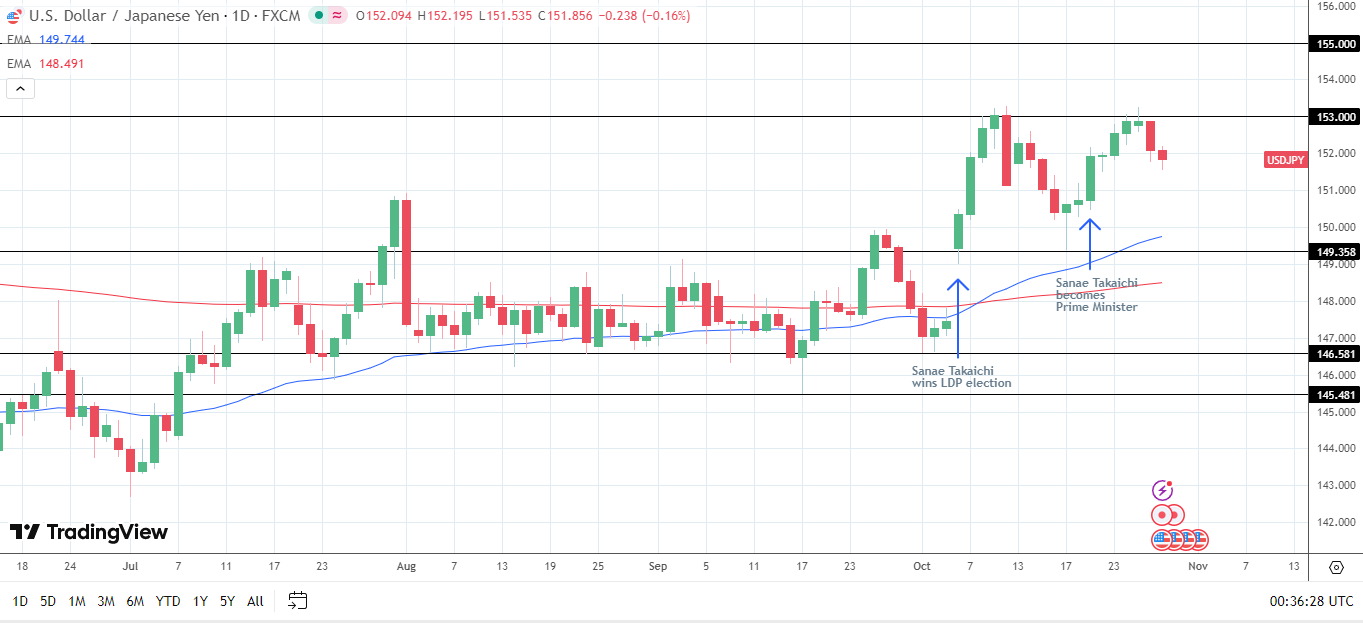



 Markets brace for what could be the most volatile week for USD/JPY this quarter. Traders face uncertainty as the Fed and the Bank of Japan’s interest rate decisions loom. This week, the pair slid from 153.257 on Monday, October 27, to 151.759 on Tuesday, October 28.
Japanese government threats of intervention triggered a sharp pullback. Traders will now briefly shift their focus away from US-China trade developments toward rising expectations of Fed rate cuts and a BoJ rate hike. Speculation about a BoJ rate hike has persisted despite Prime Minister Sanae Takaichi’s ultra-loose monetary policy stance. USD/JPY reclaimed the 153 handle following Takaichi’s appointment as Japan’s prime minister before retreating.
Polls Signal BoJ Rate Hike Timing
While Takaichi favors easy policy, economists expect the BoJ to act independently. According to the Reuters poll conducted between October 14 and 20, two-thirds of economists stated the BoJ would not delay rate hikes despite Takaichi’s election victory. The poll also revealed:
60% of economists, 45 of 75, expect the BoJ to raise interest rates by 25 basis points to 0.75% in the fourth quarter.
96% of economists, 64 of 67, predict borrowing costs to increase to at least 0.75% by March 2026.
46% of the 35 economists polled favored a January rate hike, 31% a December hike, and just 14% an October adjustment.
With markets expecting the BoJ to hike rates and the Fed to cut rates, monetary policy divergence could narrow US-Japan interest rate differentials, favoring the Japanese yen.
Given these dynamics, a narrower rate differential may push USD/JPY below 150 and the 50-day EMA. A drop below the 50-day EMA would bring the 200-day EMA and the October low of 146.585 into play. If breached, the September low of 145.481 would be the next key support level.