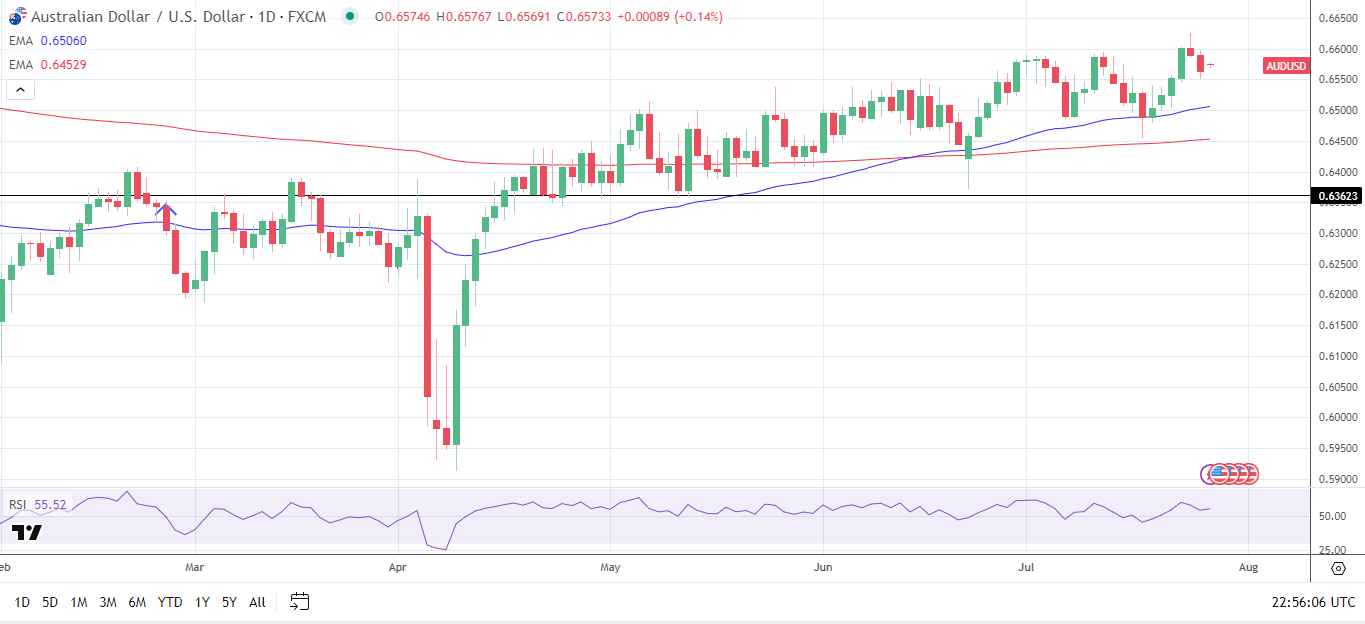



 Turning to the AUD/USD pair, the US and China will kick off a third round of high-level trade talks on July 28. Progress toward a trade deal could boost demand for the Aussie dollar.
China accounts for around one-third of Aussie exports. Given Australia’s trade-to-GDP ratio of over 50%, a trade deal may boost demand for Chinese goods, driving Aussie exports. Improving trade terms could signal a pickup in economic momentum, supporting a less dovish RBA rate path and Aussie dollar appetite.
On the other hand, stalled trade talks and the threat of higher US tariffs on Chinese goods could weigh on the Aussie dollar.
Later today, the Dallas Fed Manufacturing Index could influence US-Australian interest rate differentials and US dollar demand.
Better-than-expected numbers could signal improving demand and temper bets on a September Fed rate cut. A more hawkish Fed rate path would widen the rate differential in favor of the US dollar, dragging AUD/USD toward $0.6550. Sustained selling pressure may enable the bears to target the 50-day EMA.
However, a lower reading may indicate demand weakness, raising expectations of a Q3 Fed rate cut. A more dovish Fed policy stance could narrow the rate differential and send AUD/USD toward the $0.66 level. A sustained move above $0.66 would bring the $0.6650 level into play.