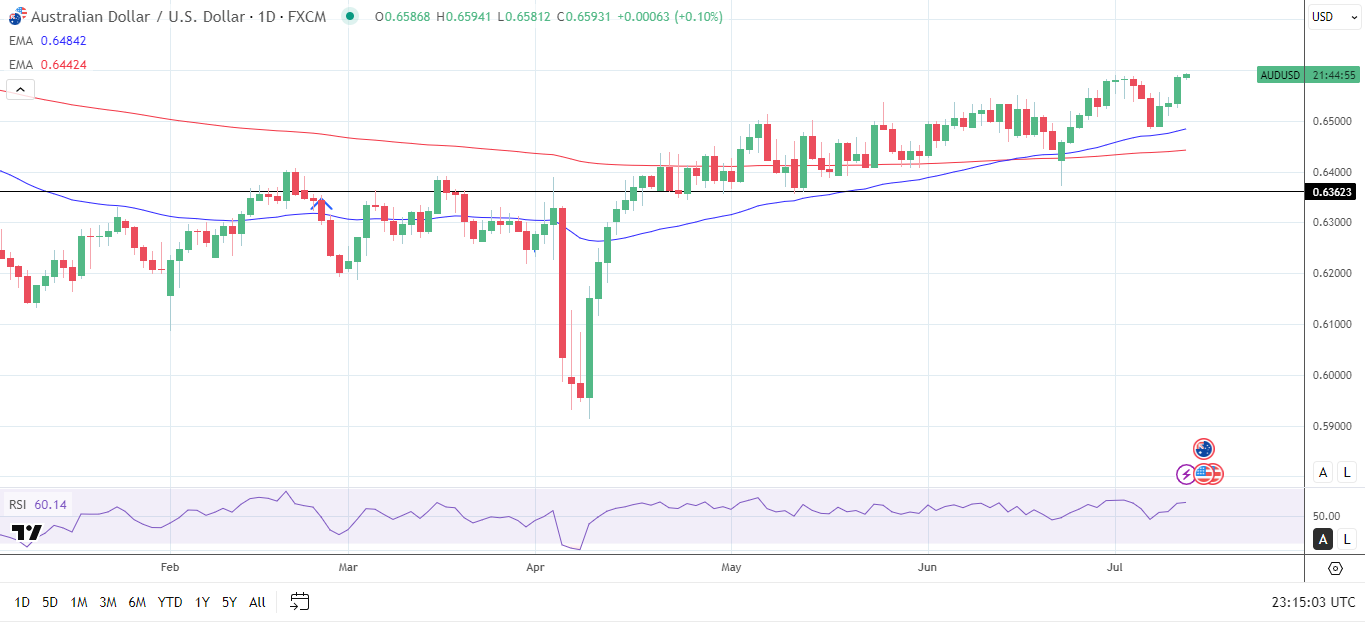



 Meanwhile, the AUD/USD pair climbed to a high of $0.65941 in early trading on July 11, its highest level since November 2024. The RBA’s surprise decision to hold interest rates has tempered market bets on multiple RBA rate cuts through H2 2025. During the RBA press conference on July 8, RBA Governor Michele Bullock downplayed the potential impact of US tariffs on the Aussie economy, stating:
“There will be an impact on us, partly driving deflationary forecasts, but the impact on Australia will likely be less severe than on the US.”
However, the RBA Governor continued to underscore the importance of a US-China trade deal, saying US trade terms with China remain crucial.
While China avoided higher tariffs this week, the US focus on transshipments from Asia could test US-China trade talks.
The US-Vietnam trade deal included a 40% levy on transshipments, while the US announced a 32% tariff on Indonesia this week. Punitive tariffs on Indonesia and Vietnam could impact Chinese exporters. In May, China exports to Indonesia and Vietnam jumped 25% and 30% year-on-year. Total Chinese exports increased 4.8% despite exports to the US plunging 43%.
Why China matters for the Aussie Dollar. Australia has a 50% plus trade-to-GDP ratio, with China accounting for around one-third of Aussie exports.
AUD/USD Daily Outlook: Fed Speakers to Impact Rate Differentials
Later today, Fed speakers could influence US-Australian interest rate differentials and AUD/USD trends.
Dovish Fed rhetoric favoring rate cuts may narrow the rate differential, favoring the Aussie dollar. A narrowing rate differential could potentially drive AUD/USD toward $0.665.
Conversely, calls to delay rate cuts could widen the rate differential, favoring the US dollar. A wider rate differential might push the pair toward $0.65.