


 Meanwhile, Chinese economic data will influence AUD/USD trends. Economists forecast China’s NBS Manufacturing PMI to rise from 49.5 in May to 49.7 in June while expecting the Non-Manufacturing PMI to remain unchanged at 50.3.
The Aussie dollar could get a boost if the Manufacturing PMI moves above the 50 neutral rate. An expanding manufacturing sector could signal an improving demand environment. Since China accounts for around one-third of Aussie exports, rising demand would bolster the economy and support the Aussie dollar.
On the other hand, a weaker print could potentially support a more dovish RBA policy stance, pressuring AUD/USD. During the May press conference, RBA Governor Michele Bullock remarked on China’s influence on monetary policy, stating:
“Australia’s economy could easily be compromised if a trade war between the US and China escalates. Depending on where we end up on trade developments, there might be more interest rate adjustments. But for now, rates are in the right place.”
AUD/USD Daily Outlook: US Data and the Fed to Drive Rate Differentials
Later today, the US private sector data and Fed speakers will influence US-Australian interest rate differentials and AUD/USD trends.
Weaker-than-expected data and dovish Fed commentary would fuel Q3 Fed rate cut bets, narrowing the rate differential favoring the Aussie dollar. This could send AUD/USD toward $0.66.
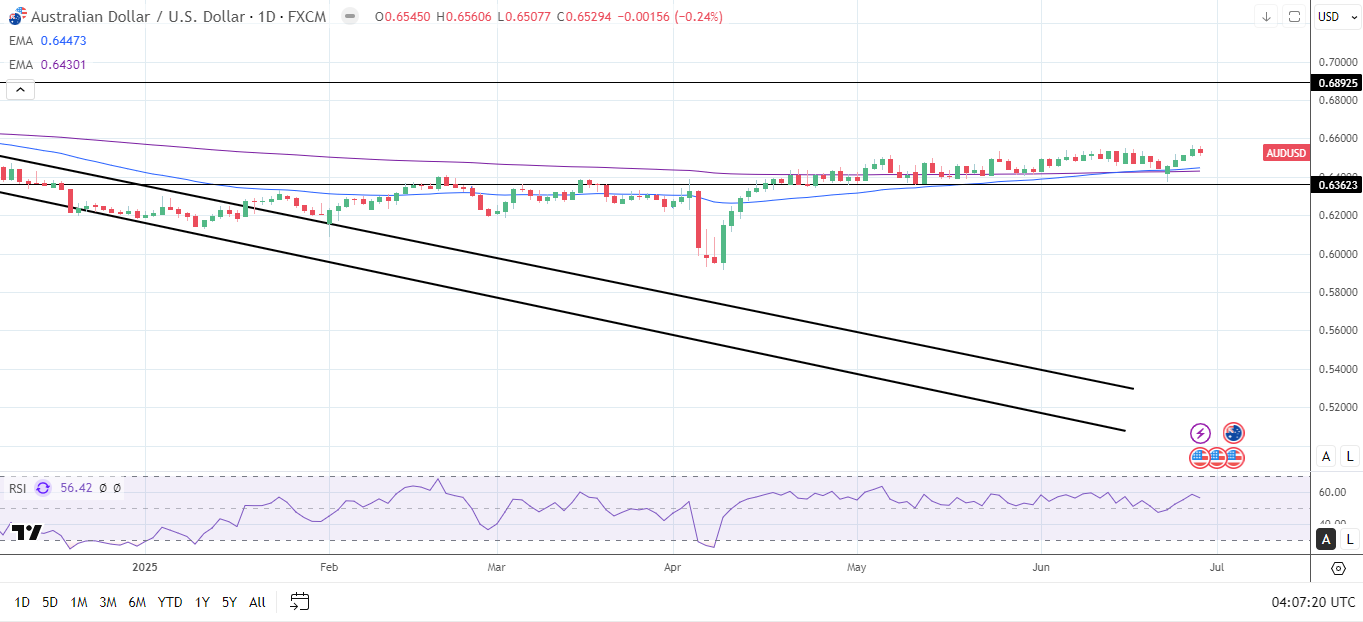
Conversely, better-than-expected US data and hawkish Fed cues may widen the rate differential favoring the US dollar. Widening rate differentials on reduced Fed rate cut bets may drag AUD/USD toward $0.65, exposing the 50-day and 200-day Exponential Moving Averages (EMA).