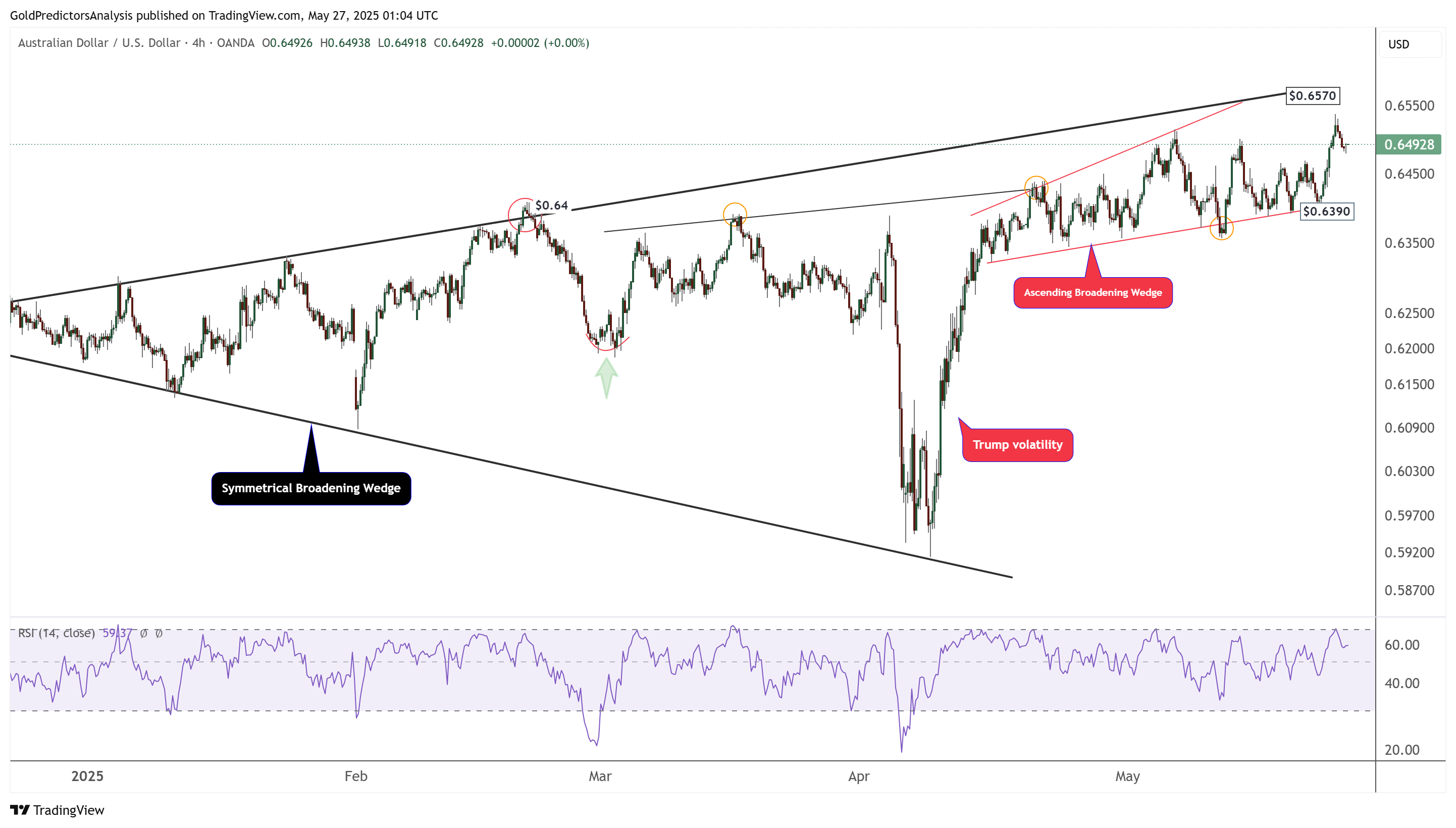



 The Australian Dollar holds near the psychological 0.6500 level after retreating from a six-month high of 0.6537. Although the pair remains under pressure, the broader weakness in the US Dollar has strengthened the AUD/USD. The US Dollar Index trades near 98.80, marking its third straight day of losses. This decline is driven by fiscal concerns in the US, giving short-term support to the Aussie.
Despite this, AUD faces challenges from the dovish RBA outlook. The central bank recently cut interest rates by 25 basis points, and Governor Michele Bullock hinted at more cuts if the economic outlook worsens. This weakens rate differentials in favor of the USD, capping AUD upside. Markets expect the RBA to remain cautious, which may prevent AUD/USD from sustaining a strong rally.
The recent 90-day truce in US-China trade talks has supported the AUD, as China is Australia’s largest trading partner. However, tensions remain. China’s Commerce Ministry condemned US chip sanctions as “unilateral bullying.” Australia-China ties are also strained, with Beijing criticizing Australia’s plan to revoke the Darwin Port lease to a Chinese firm. These geopolitical frictions could dampen AUD’s performance if tensions escalate.
Moreover, Trump’s tariff extension on the EU to July 9 has improved market sentiment. Risk appetite returned after the 50% tariff threat was delayed. This delay boosts AUD, but the upside remains fragile and dependent on Fed signals and Australia-China diplomacy.
The 4-hour chart for AUD/USD shows that the pair is trading within an ascending broadening wedge pattern. The boundaries of this pattern lie between the $0.6390 and $0.6570 levels. Despite the ongoing consolidation, the formation of the ascending broadening wedge suggests strong volatility ahead. The upward trend will likely continue since the price has rebounded from the long-term support at $0.5900.