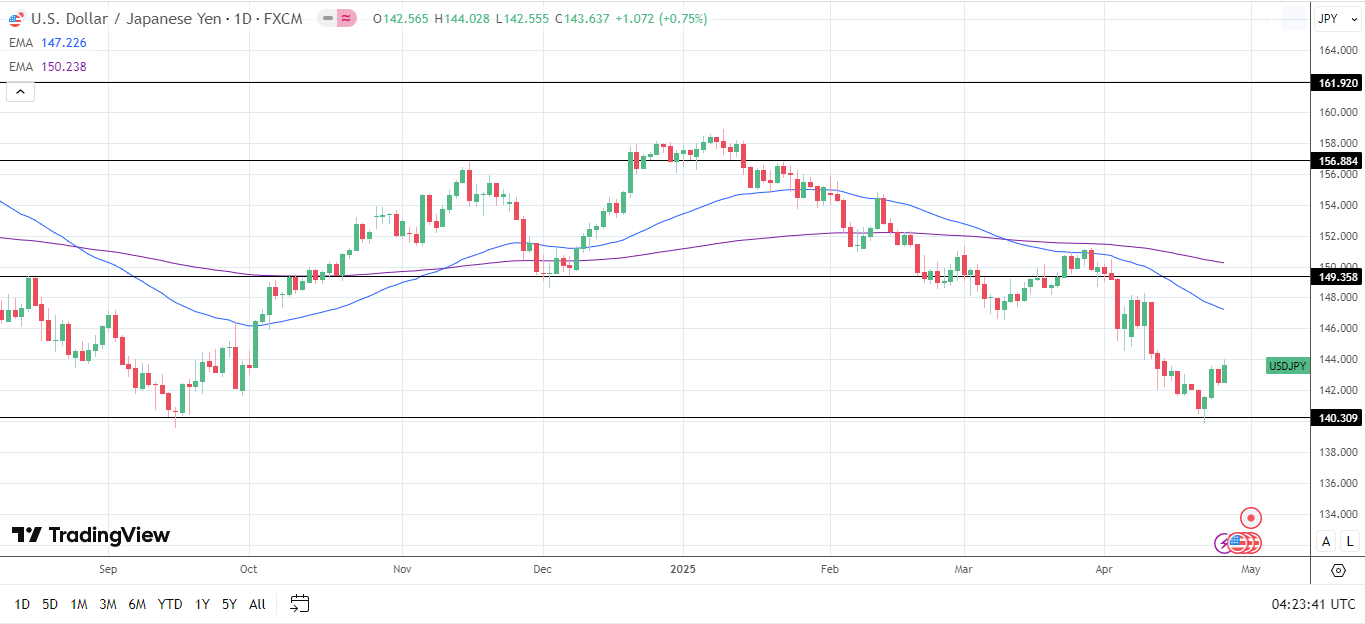



 Trade developments lifted demand for risk assets in the week ending April 25 as President Trump announced the resumption of US-China trade talks. Optimism over an end to the tit-for-tat tariff measures drove US dollar demand and snapped the US Dollar Index’s four-week losing streak.
Risk-on sentiment weighed on the Japanese Yen and gold. The USD/JPY gained 1.08%, closing at 143.637, while gold fell 0.25% to $3,319.
Looking ahead, trade developments will remain a key driver for the USD/JPY pair. However, investors should also consider the Bank of Japan’s monetary policy decision and key economic indicators that could influence price action.
Retail Sales and Japan’s Economy Outlook
Focus turns to Japanese retail sales due Wednesday, April 30. Economists forecast retail sales to rise 3.5% year-on-year in March, up from 1.4% in February. A jump in private consumption could boost bets on an H1 2025 Bank of Japan rate hike. With private consumption accounting for 55–60% of Japan’s GDP, stronger spending could signal upward inflationary pressure and broader economic resilience.
Significantly, a surge in spending would reflect the effects of rising wages on household spending trends, crucial for the BoJ.
Rising bets on a near-term BoJ rate hike would boost Yen demand. Conversely, a softer retail sales reading may pressure the Yen.
Daily Chart
On the daily chart, the USD/JPY trades below the 50-day and 200-day EMAs, maintaining a bearish bias.
A break above last week’s high of 144.028 could signal a move toward 145. A decisive move through 145 may bring the 50-day EMA into view.
On the downside, a drop below 142 could expose last week’s low of 139.883 and the September 2024 low of 139.576.