


 USD/JPY Soars as Trade Developments Hit BoJ Policy Bets
USD/JPY soared as President Trump’s tariffs impacted expectations of a Bank of Japan rate hike, widening the US-Japan interest rate differential in favor of the US dollar. US labor market data and airline earnings and forecasts signaled a resilient economy, boosting US dollar demand.
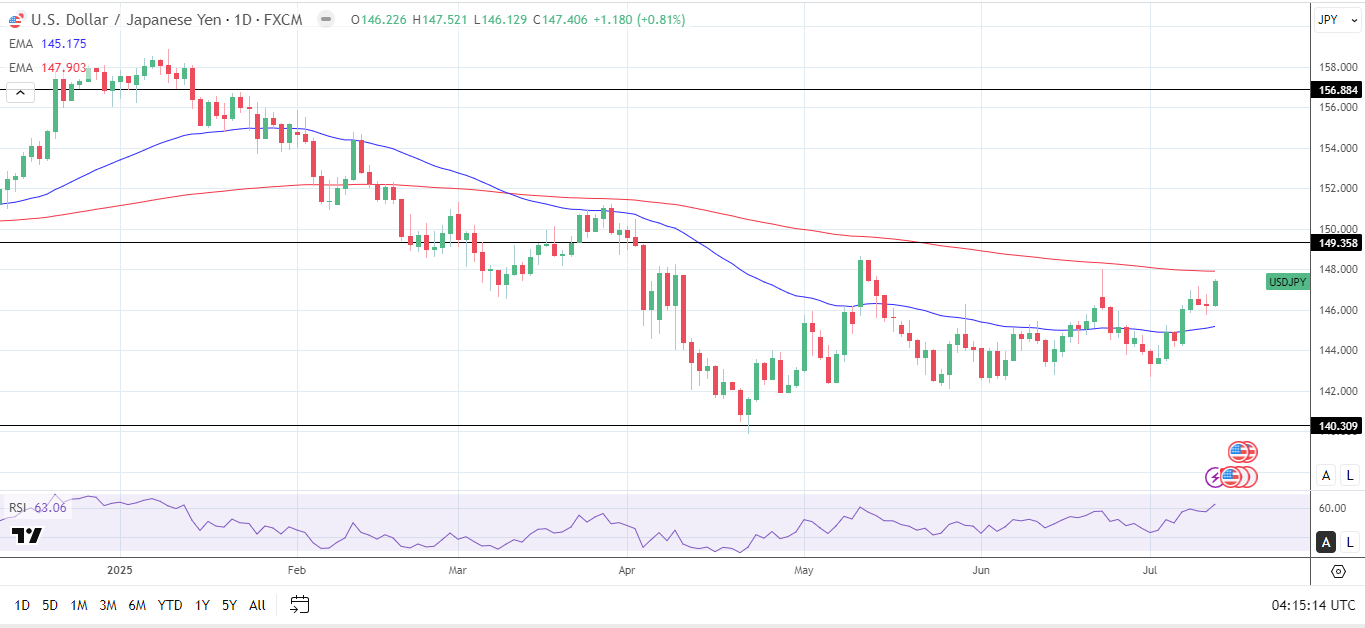
USD/JPY slipped briefly to a low of 144.221 before soaring to a high of 147.521. Despite a modest pullback, the pair ended the week up 2.01% at 147.405.
Outlook: Trade Talks, Inflation, and Central Banks in Focus
US-Japan trade developments will continue to drive USD/JPY trends. President Trump announced a 25% tariff on Japanese goods, effective August 1. Higher tariffs may further weaken demand for Japanese goods, company profits, and potentially wage growth. Weaker trade terms and softer wage growth could weigh on sentiment and household spending.
The net effect would be a loss of economic momentum and a cooler inflation outlook, potentially curbing expectations of a Bank of Japan rate hike.
Meanwhile, key economic indicators will give investors insights into the effects of tariffs.
Machinery Orders in Focus
On Monday, July 14, machinery order numbers from Japan will reflect business sentiment and potentially wage growth trends. Economists forecast machinery orders to fall 1.5% month-on-month in May, following April’s 9.1% plunge.
Weaker-than-expected orders could signal waning business sentiment, potentially curbing investment. Falling investment and cost controls may pressure wage growth, dampening consumer spending. A pullback in spending may dampen inflation, supporting a less hawkish BoJ rate path.
Conversely, rising orders could boost sentiment and wages, reviving BoJ rate hike bets. Sentiment toward the BoJ’s policy stance would influence Yen demand.
Daily Chart
On the daily chart, the USD/JPY trades above its 50-day Exponential Moving Average (EMA) while remaining below the 200-day EMA. The EMAs signal a bullish near-term bias but a bearish longer-term outlook.
A breakout above the 200-day EMA and 148 could pave the way to the 149.458 resistance level. Sustained buying pressure may bring the March high of 151.301 into play.
On the downside, a drop below the 50-day EMA and the crucial 145 support level could enable the bears to target 142.5, a crucial support level in May and early June.
The 14-day Relative Strength Index (RSI) sits at 63.06, indicating USD/JPY can climb to 150 before entering overbought territory (RSI > 70).