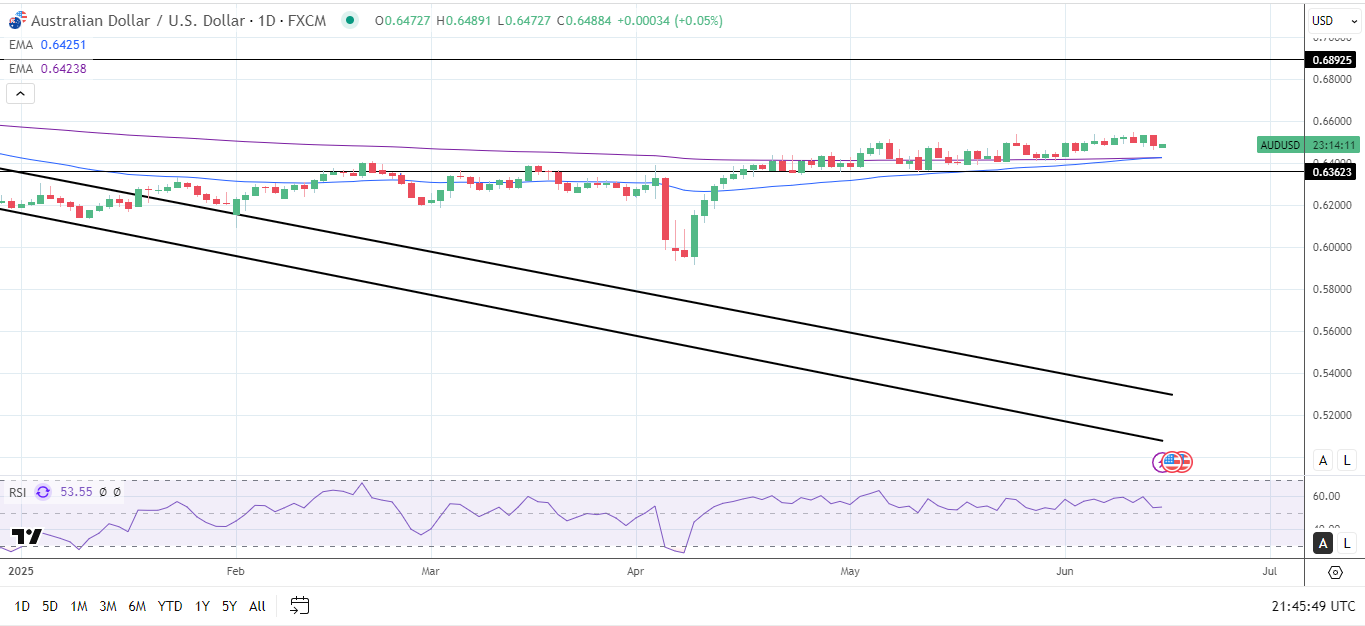



 Economic data from China and updates from the Middle East will influence AUD/USD trends on June 16. Progress toward an Israel-Iran ceasefire could boost Aussie dollar demand, sending AUD/USD toward $0.65, while an escalation may pull the pair toward $0.64.
While updates from the Middle East will be crucial, economic data from China will also influence Aussie dollar appetite. Retail sales, industrial production, fixed asset investment, and unemployment data will offer insights into China’s economy midway through the second quarter.
Better-than-expected data could ease fears of US tariffs impacting China’s economy. Given that China accounts for one-third of Aussie exports, an improving economic backdrop may boost the demand for Aussie goods. Improving Australia-China trade terms would bolster the Australian economy, supporting a less dovish RBA stance. However, weaker-than-expected readings may signal a waning demand environment, supporting a more dovish RBA stance.
In May, RBA Governor Michele Bullock warned of the potential impact of a US-China trade war on the Aussie economy and RBA policy, stating: “Australia’s economy could easily be compromised if a trade war between the US and China escalates. Depending on where we end up on trade developments, there might be more interest rate adjustments.”
Aussie Dollar Daily Outlook: US Manufacturing Sector Data and Near-Term Action
Later today, the NY Empire State Manufacturing Index will influence AUD/USD trends via US-Aussie interest rate differentials.
Improving manufacturing sector activity may support a less dovish Fed stance, widening rate differentials. A wider rate differential, favoring the US dollar, may drag AUD/USD below the 200-day and 50-day EMAs, exposing the $0.64 level. Conversely, a lower print could narrow the rate differential, sending AUD/USD toward $0.65.