


 The Australian Dollar has been consolidating in wide ranges against the US Dollar over the past month. The chart below shows that the Westpac Consumer Confidence Index rose to 92.1 in May. This increase reversed the previous 6.0% drop in April and marked the third rise in 2025. However, AUD/USD still dropped on Monday due to the strength of the US Dollar following the trade deal between China and the United States.
Under the US-China trade deal, US tariffs on Chinese goods dropped from 145% to 30%. Moreover, China reduced tariffs on US imports from 125% to 10%. These steps reduced global risk, strengthened the US Dollar, and pressured the Australian Dollar.
On the other hand, markets have revised their expectations for Australian rate cuts. Forecasts now expect the RBA to lower rates to 3.1% by year-end. However, a 25-basis-point cut still appears likely at the next RBA meeting. In addition, weaker exports and 33 consecutive months of industry contraction continue to weigh on the Australian outlook.
The chart below shows China’s CPI and PPI readings, which indicate slowing inflation. The CPI declined by 0.1% year over year, and the PPI also fell.
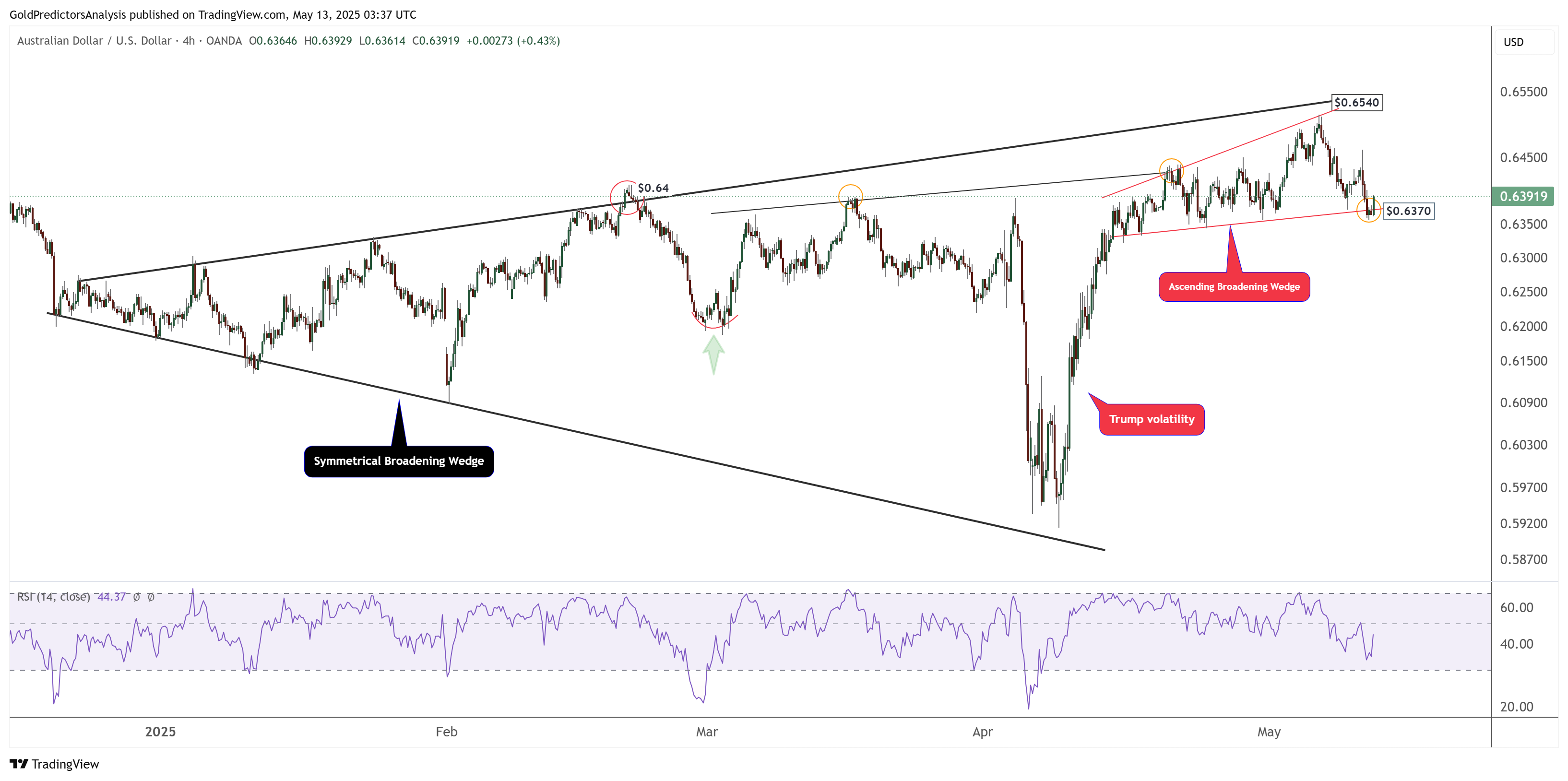
The 4-hour chart for AUD/USD shows that the pair is trading within an ascending broadening wedge pattern, indicating strong volatility. Following the US-China trade deal, the drop in AUD/USD found support at $0.6370, near the wedge’s lower boundary, and the pair has since rebounded. The broader outlook remains bullish, but a break above $0.6540 is needed for the bulls to regain control.